
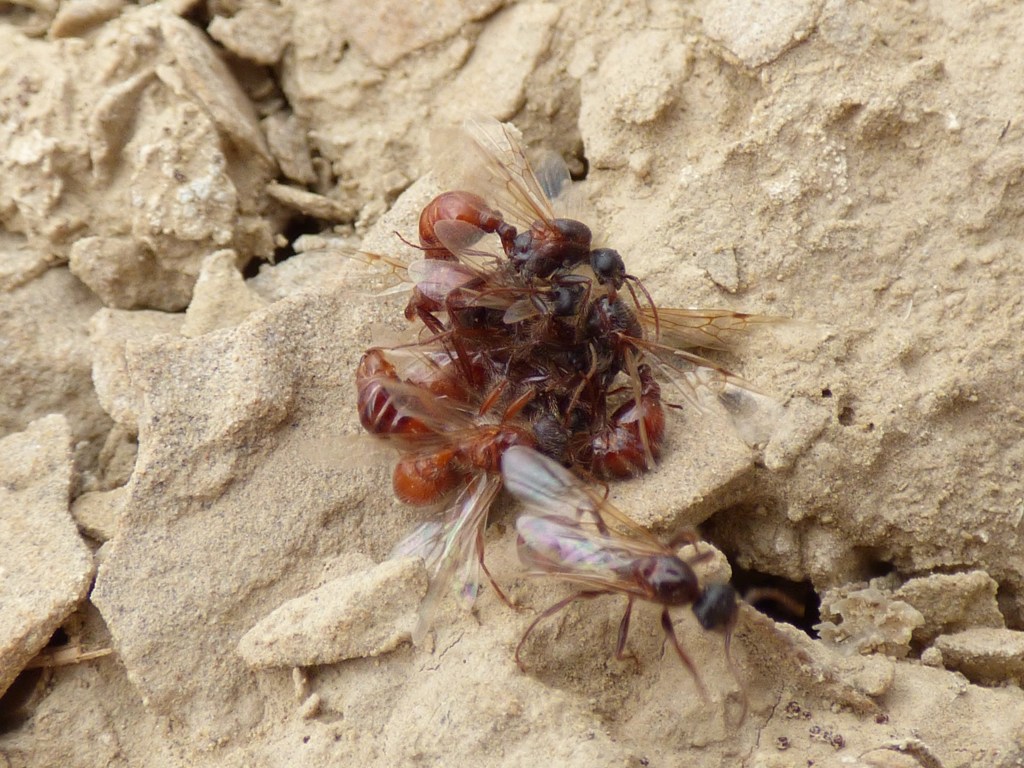
When colonies reproduce, they make winged males and females-the new queens. These reproductives fly from their home nest to mating swarms at the tops of hills. Mated queens fly from the hilltops and begin to found a nest, while males die at the tops of the hills.
The colonies that are large enough to reproduce make several reproductive decisions every year. Should we reproduce this year? If resources are not available, then reproduction will not occur. During times of drought, there may be very little reproduction by any colony. Even in years where there is sufficient rainfall, it may occur at times of the year that affect the presence of specific plants. If those plants are not around a specific colony, it may not reproduce. Most colonies do not reproduce every year.
If a colony does reproduce, then it will divide its reproduction among male and female offspring (the new queens). Virtually all colonies produce both males and females when the reproduce, but they tend to produce a specific sex ratio of offspring (the proportion of males and females). Some produce more males while other colonies produce more females.
The investment in males and females by the mother colony influences the size of the new males and queens. For males, increased size means that he will have a greater chance to mate with more females and he transfers more sperm than a smaller male. Colonies gain an advantage if they can produce larger males.
Investment in the size of new queens is also significant. Larger queens are more likely to survive the period of colony founding than smaller queens. However, it is most important for queens to be larger than a threshold size in order to survive. Colonies gain an advantage when they produce females that are larger than this threshold, but do not gain much of an advantage if they are still larger.
 Cole - Wiernasz Lab