In this figure we can see the overall pattern of density of nests of harvester ants. The scale is in meters so that each grid is a 50 x 50 quarter hectare plot.
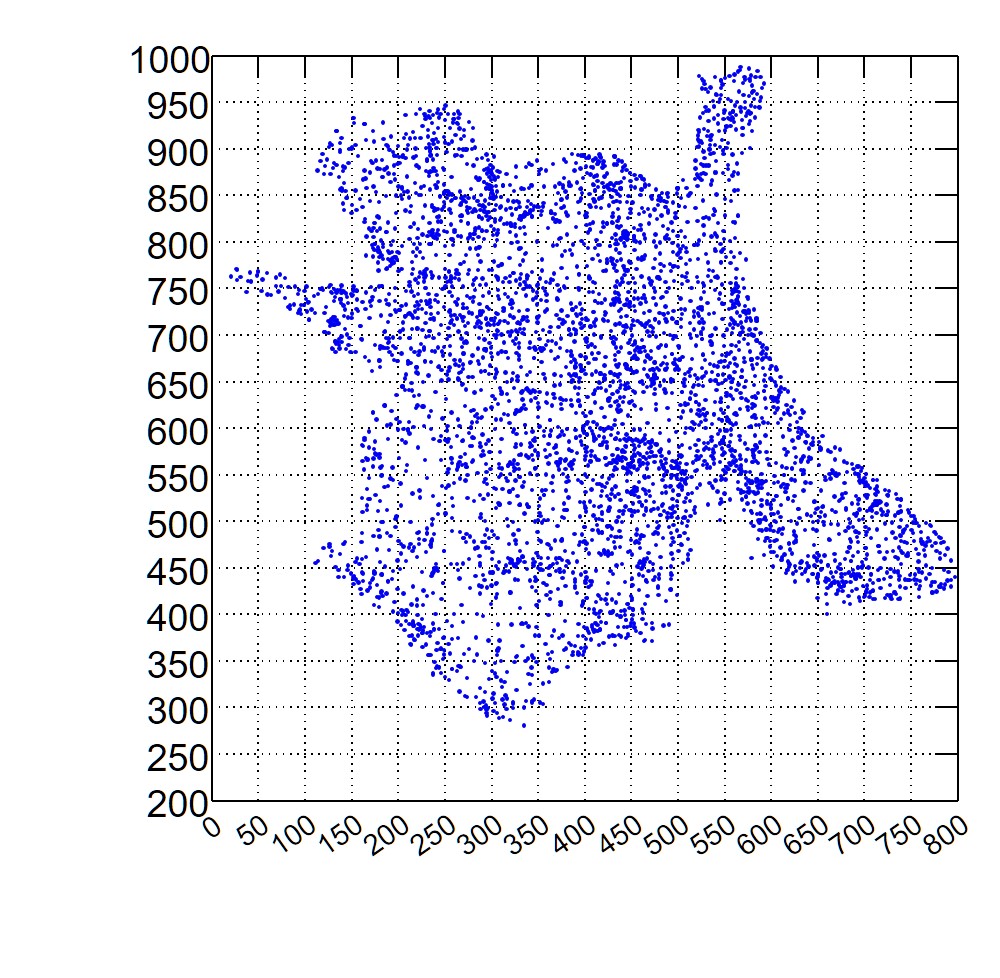
Some locations have far more ant colonies than others. We considered how much of this pattern of density variation was due to differences in the quality of the local site or due to limitation in the ability of the queens that are the founders of colonies to get to certain locations. In the first case habitats vary in quality for ants and areas that are better for ants have more colonies. It suggests that the local population density is governed by the availability of resources. The second explanation suggests that density variation is governed by dispersal. Even if an area is highly suitable for ants, it may have fewer colonies because the queens do not often get to a location.
The resource quality hypothesis seems plausible since ants need particular resources from seeds in order to survive and the quality of vegetation can vary considerably from one place to another.
The recruitment limitation hypothesis only begins to seem plausible because of the mating habits of this species. Queens and males disperse from their natal nests during the annual mating flight that is cued by summer rainfall. All of the reproductive ants fly to the tops of prominent hills to mate. The males die on the hilltop, while the queens after mating disperse from the hilltops. There are specific hills that have mating aggregations year after year and potentially represent a fixed location of a queen source. Some places are much further from these important sites than others.
It turns out that the density of colonies falls off as the distance from a specific hill–Hill 7–increases. This is a hill that always has a mating aggregation during years when there is any reproduction. It can have a spectacularly large mating swarm during years of good reproduction. The density of new recruits and of dispersing queens both fall off as you move away from Hill 7.
We were able to experimentally introduce queens to plots and show that increased abundance of queens arriving at plots increased recruitment compared to matched control plots that did not have additional queens. This is important because it shows that the abundance of queens influences density of colonies.
The importance of recruitment limitation to the ants means that some locations (those near Hill 7) are more likely to experience strong intraspecific competition for resources, while locations that are far from Hill 7 will not be saturated with ants and are likely to experience less competition.
 Cole - Wiernasz Lab