One of the most important data sets that we have been compiling is information on one of the basic types of information for any species–their demography. How long do colonies live (answer: a maximum of 45 years). How does the chance of dying change with age (see below). What is the pattern of reproduction with age? How many new colonies are started each year and how many colonies die?
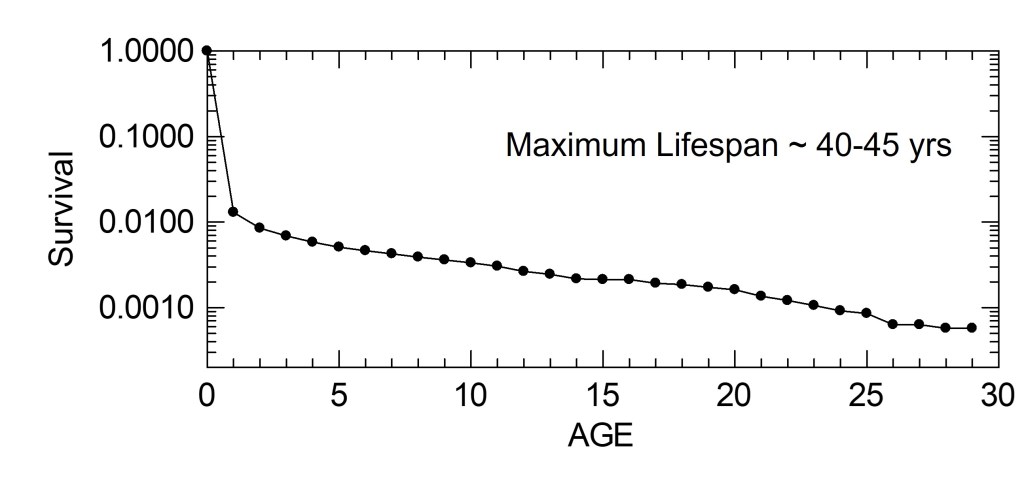
As you can see colonies have enormous mortality during their first year. For every queen that starts a colony, fewer than 2% survive to one year old. Mortality can be fairly high for the first few years, but it declines as colonies get older.
The chance that a colony reproduces also increases with the age of a colony. Colonies rarely reproduce when they are younger than five years and we know of colonies that are twenty years old and still have not reproduced. Even when colonies do begin to reproduce, it is unlikely that they will reproduce every year. During droughts, most colonies will not reproduce, but even during the best of times, some vigorous colonies just do not produce reproductives.
The key to beginning to understand the demography of harvester ants is realizing that most demographic properties are really a function of the size of the colony rather than the age of the colony. Survival is much more tightly related to size than age–reproduction is much more tightly related to size than age. This is likely to be true of almost all species of ants and means that we should start to think about the pattern of survival and reproduction as being more akin to plants or fish populations.
Recruitment of new colonies into the population is extremely variable from year to year. For there to be a large amount of recruitment into the population, there must be a large production of reproductives, which in turn requires lots of food and relatively large amounts of rainfall. In some years (when there are two consecutive years with greater than normal rainfall) there may be hundreds of new colonies, while in other years, there may only be a few dozen new colonies added to the population.
To explore more about ant demography see, Cole (2009).
 Cole - Wiernasz Lab